AGENT
DECK

Good agents.
Great blueprints.

Explore agent architectures. Build your own.

Browse the collection

64 architecture families384 application presetsFree to explore
DECK ONLINEREADY
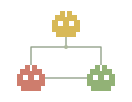
Three small AI agents connected as a team: yellow coordinator, brick-red researcher and leaf-green builder
DECK INDEX384possibilities on the shelf
EXPLORE → BUILD → EVALUATE_

Little agents. Shared ideas.

The cartridge collection.

/

384 cartridges on the shelf

Take the deck
into your IDE.

One free, offline skill. Search every architecture, then load only the blueprint you need.

CodexCursorClaude CodeCopilot
Download IDE skill

Free · MIT · Offline catalog
Helper requires Node.js 20+

Full installation guide
Install in your project

Extract the ZIP and copy the entire agent-deck folder to the location for your tool. Keep scripts and references together.

Project skill locations
ToolFolder in your project
Codex, Cursor, Copilot.agents/skills/agent-deck/
Claude Code.claude/skills/agent-deck/

Reload skills or open a fresh session. Use $agent-deck in Codex, or /agent-deck in Cursor, Claude Code and Copilot.

Use Agent Deck to choose an architecture for my document assistant. Compare a simple baseline with an advanced alternative, then adapt it to my stack.

The package needs no account or API key. Your assistant supplies the AI; blueprints still need implementation and evaluation.

Patterns with provenance.
Room for your own experiments.

These are original, framework-neutral design presets informed by papers and engineering guides. They include implementation contracts and evaluation plans. Their performance has not been benchmarked.

FIELD NOTES & ORIGINAL SOURCES

The reading room.

Start with a practical guide. Follow a mechanism to its paper. Keep the original authors in view.

INSIDE AGENT DECK

Small cartridges.
Clear contracts.

Explore 64 architecture families and 384 application presets, spanning basic workflows through expert systems.

  1. Find a fit. Search by mechanism, application or complexity. The same family has six task-specific adaptations.
  2. Inspect the wiring. Follow colored agent roles, tools, memory and conditional transitions. Select a node to inspect its contract, then check budgets and failure modes.
  3. Make it yours. Download a JSON blueprint or Markdown guide. Implement the model and tool adapters in your preferred runtime.
  4. Measure it. Use the fixture and acceptance criteria. Compare against a direct-call baseline before adding complexity.

Blueprints are design specifications, not executable agents or drop-in framework configurations. No account or API key is required to browse. Optional usage analytics respects your browser privacy preference; see our privacy notice.

PUT THEM SIDE BY SIDE

Find the right tradeoff.